Police Scanner Myths vs. Facts: Setting the Record Straight
Police departments cite officer safety, victim privacy, and operational security when justifying radio encryption. But do these claims hold up to scrutiny? Here's what the evidence actually shows.
When police departments propose encrypting radio communications, they often rely on a set of common justifications. These claims sound reasonable on the surface—who wouldn't want to protect officer safety or victim privacy?
But when you ask for evidence, something interesting happens: there isn't any.
Below, we examine the most common myths about police scanners and encryption, backed by documented evidence, official records searches, and real-world examples.
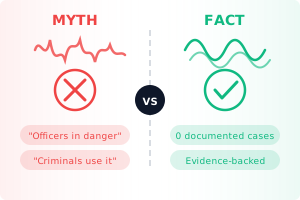
Common Myths About Police Scanners
What departments claim vs. what the evidence shows
Myth #1: Criminals Use Scanners to Ambush Officers
ShareThe Claim:
Police departments argue that criminals monitor scanners to track officer locations and plan ambushes, making encryption necessary for officer safety.
The Evidence:
Zero documented cases exist.
- Palo Alto, California: After a 3-year records search, police found "no responsive records" of incidents where scanner access led to officer harm
- Broadcastify: The CEO of the world's largest scanner streaming platform states they have never received evidence of scanner-related officer harm in decades of operation
- Multiple police departments: When pressed for documentation during city council meetings, departments admit they have zero cases to cite
The Reality:
This is perhaps the most pervasive myth—and the easiest to debunk. If scanner access truly endangered officers, there would be incident reports, injury claims, case studies, or at minimum anecdotal evidence. Instead, there's complete silence when departments are asked to provide proof.
Modern criminals don't need scanners when they have:
- Real-time GPS apps (Waze, Google Maps) showing police locations
- Social media reports from bystanders
- Lookouts with cell phones
- Visual observation of marked police vehicles
The scanner ambush scenario is a theoretical concern with no real-world basis.
The Real Security Threat is Inside
While departments claim scanners threaten officer safety (with zero evidence), the documented threat comes from within. 40 documented cases show police employees selling database access, tipping off criminals, and leaking confidential information—including one Chicago officer who allegedly sold access to his encrypted radio for $500 payments.
See Documented Insider Threat Cases →Myth #2: Scanner Access Endangers Victim Privacy
ShareThe Claim:
Open scanners broadcast sensitive victim information—names, addresses, medical details—that should remain private. Encryption is necessary to protect victims.
The Evidence:
Hybrid systems solve this without blanket encryption.
- Victim names and sensitive details are typically transmitted via Mobile Data Terminals (MDTs), not radio
- Officers are trained to use codes or generic descriptions on radio ("victim," "complainant," "individual") rather than broadcasting names
- Tactical or sensitive channels can be encrypted while routine dispatch remains open
- Temporary encryption can be activated for specific incidents (domestic violence, sexual assault) without encrypting everything
The Reality:
Victim privacy is a legitimate concern—but blanket encryption is like burning down your house to kill a spider. Proportional solutions exist:
- Officer training: Teach proper radio protocol to avoid broadcasting identifying information
- Code systems: Use numeric codes for sensitive incident types
- Secondary channels: Switch to encrypted channels only when needed for specific incidents
- MDT usage: Send sensitive information via text-based systems, not voice radio
Many police departments have successfully protected victim privacy for decades without encryption. The ones that didn't were failing to follow basic radio protocols—a training issue, not a technology issue.
Myth #3: Encryption Makes Communications More Secure
ShareThe Claim:
Encrypted digital radio systems are more reliable, secure, and effective than traditional open radio communications.
The Evidence:
Encryption creates new problems and failures.
- Interoperability issues: Different agencies' encrypted systems often can't communicate with each other during multi-agency responses
- Technical failures: Documented cases of garbled transmissions, including an officer calling "I'm hit" but the message was unintelligible due to encryption issues
- Complexity costs: Encrypted systems require expensive infrastructure, ongoing maintenance, and regular key distribution
- Training challenges: Officers must manage encrypted vs. open channels, creating confusion during high-stress situations
The Reality:
Encryption adds a layer of technical complexity that can actually reduce communication reliability:
- Fire and EMS coordination: When police encrypt but fire departments don't, coordination during joint responses becomes difficult
- Mutual aid scenarios: During major incidents requiring neighboring departments, encrypted systems create barriers to communication
- Equipment failures: Encryption keys can fail to load, radios can lose sync, and systems can go down—all leaving officers unable to communicate
- Cost-benefit failure: Departments spend millions on encryption infrastructure that provides no documented safety benefit while creating real operational challenges
Myth #4: Delayed Feeds and FOIA Provide Sufficient Access
ShareThe Claim:
Even with encryption, the public and media can access police radio audio through delayed streaming (like Chicago's 30-minute delay) or Freedom of Information Act (FOIA) requests.
The Evidence:
Delayed audio arrives after the incident has concluded.
- Chicago's 30-minute delay: Media outlets describe it as nearly worthless for timely reporting; by the time audio is available, incidents are over
- Active censorship: Chicago removes transmissions deemed "sensitive" before release—censorship in its purest form with no oversight
- FOIA delays: Requests can take weeks or months; some departments charge thousands of dollars in fees
- Public safety impact: During active emergencies (shooters, natural disasters), delayed information is too late to help people take protective action
The Reality:
Real-time access and delayed access serve completely different purposes:
Real-Time Access (What We're Losing)
- Immediate public safety alerts during active threats
- Breaking news coverage as events unfold
- Situational awareness for residents
- Independent verification of police accounts
- Family notification during emergencies
Delayed/FOIA Access (What They Offer Instead)
- Historical research only
- After-the-fact accountability (maybe)
- Censored/incomplete records
- Too slow for emergency response
- Dependent on government cooperation
As one journalist put it: "By the time we get the audio, the police have already issued their official statement and controlled the narrative. We've lost our ability to independently verify what actually happened."
Myth #5: Are Police Scanners Illegal?
ShareThe Claim/Question:
Many people wonder if owning or listening to police scanners is illegal, or if encryption is being implemented because scanner use violates the law.
The Evidence:
Police scanners are completely legal in the United States.
- Federal law: It is 100% legal to own and operate a police scanner receiver
- Listening is legal: You can listen to any unencrypted radio transmission on public airwaves
- Limited restrictions: You cannot use scanner information to commit crimes or interfere with police operations (but this has never been documented as an actual problem)
- No licensing required: Unlike ham radio transmission, scanner listening requires no license or registration
The Reality:
Police scanners have been legal and widely used for decades by:
- Journalists: Essential tool for breaking news coverage
- Emergency managers: Situational awareness during disasters
- Community members: Understanding police activity in their neighborhoods
- Researchers: Studying crime patterns, traffic safety, and emergency response
- Hobbyists: Radio enthusiasts monitoring public safety communications
Encryption isn't being implemented because scanners are illegal—they're not. It's being implemented because police departments want to control information and avoid the accountability that comes with public oversight.
Myth #6: Only Criminals and Nosy People Use Scanners
ShareThe Claim:
Police scanner listeners are either criminals trying to evade law enforcement or voyeuristic busybodies with nothing better to do.
The Evidence:
Scanner users serve critical public interest functions.
- Professional journalists: RTDNA (Radio Television Digital News Association) has campaigned against encryption since 2023
- Safety advocates: Groups like Walk Bike Berkeley use scanner data to document crashes and improve traffic safety
- Emergency volunteers: Community emergency response teams coordinate with professional responders
- Families: Parents monitoring school lockdowns, residents tracking wildfires, people locating loved ones during incidents
The Reality:
Real people who use scanners for legitimate purposes:
- Highland Park shooting survivors: Used scanners to find safe routes and locate family members during active shooter event
- Colorado residents: Monitored wildfire evacuations and active shooter situations before encryption went into effect
- Traffic safety researchers: Document accident patterns to advocate for infrastructure improvements
- Accountability advocates: Monitor police activity during protests and community events to ensure proper conduct
- Local reporters: Small news outlets that can't afford full-time police reporters rely on scanners for breaking news
Dismissing scanner users as criminals or voyeurs ignores the vast majority of legitimate, public-interest uses that benefit entire communities.
Myth #7: Encryption is a New Technology Standard
ShareThe Claim:
Police radio encryption is simply the natural evolution of radio technology—a modern standard that all departments are adopting as systems get upgraded.
The Evidence:
Encryption is a policy choice, not a technical requirement.
- Modern digital radio systems (like P25) can operate with or without encryption—it's a switch, not an inherent feature
- Many departments upgrading to digital systems have chosen to keep communications open
- The surge in encryption correlates directly with 2020 protests, not technology refresh cycles
- Some departments that encrypted are now reconsidering due to community backlash
The Reality:
The timing tells the real story:
- Pre-2020: Digital radio systems existed for years without widespread encryption
- Summer 2020: George Floyd protests lead to open scanners documenting police misconduct, racist remarks, and excessive force
- Post-2020: Rapid acceleration of encryption policies nationwide, often implemented quickly without community input
- Present day: Departments cite "officer safety" but the evidence points to avoiding accountability
As one analysis put it: "The technology enables encryption, but police departments are choosing to use it—and that choice is happening overwhelmingly in response to increased scrutiny and calls for accountability, not because of any documented safety need."
Myth #8: There's a Federal Mandate to Encrypt
ShareThe Claim:
Police departments increasingly claim they're required to encrypt by federal mandate—that CISA, DHS, or P25 standards require full encryption of all radio communications.
The Evidence:
CISA/SAFECOM explicitly says encryption is NOT required for all communications.
- Direct quote from CISA: "Not all public safety communications need to be encrypted"
- Decision is local: "Public safety agencies must determine what type of information should be encrypted"
- Grant requirements: Federal grants only require AES-256 standards if you choose to encrypt—they don't require encryption itself
- Interoperability concerns: CISA warns that encryption "can also increase the system cost, and impact interoperability and public safety operations"
What Federal Guidance Actually Says:
CISA and SAFECOM provide guidance about encryption standards—not encryption mandates:
- If you encrypt: Use AES-256 (not older DES or proprietary algorithms)
- If you use federal grants: Equipment with encryption must meet P25 standards
- The choice is yours: "Considerations for Encryption" documents help agencies determine whether to encrypt, not mandate that they must
From CISA/SAFECOM Official Guidance:
"While encryption is critical to certain public safety disciplines and missions, it can also increase the system cost, and impact interoperability and public safety operations. Public safety agencies must determine what type of information should be encrypted and the method of encryption; recognizing that not all public safety communications need to be encrypted."— CISA SAFECOM, FPIC Encryption Documents
The Reality:
When police departments claim a "federal mandate," they're either:
- Confused: Mistaking AES-256 encryption standards (required IF you encrypt) for encryption mandates (which don't exist)
- Misleading: Deliberately misrepresenting federal guidance to avoid community opposition and public debate
- Deflecting: Using "the feds made us do it" as cover for a decision they want to make anyway
Ask your department: "Can you show me the specific federal law or regulation that requires you to encrypt routine dispatch communications?" They won't be able to—because it doesn't exist.
How to Respond to the "Federal Mandate" Claim:
- Request the specific federal statute or regulation requiring encryption
- Point to CISA's "Determining the Need for Encryption" guidance which frames it as a decision, not a requirement
- Quote CISA: "Not all public safety communications need to be encrypted"
- Note that many P25 digital systems operate without encryption—it's a switch, not a requirement
- Ask why the department is misrepresenting federal guidance to avoid public input
The Pattern is Clear
When you examine each justification for encryption, a pattern emerges:
- Reasonable-sounding claim (officer safety, victim privacy, operational security)
- Zero documented evidence when departments are asked to prove the problem exists
- Alternative solutions ignored (hybrid systems, training, protocols)
- Real harms dismissed (lost public safety alerts, reduced accountability, hindered journalism)
This isn't about safety or privacy. It's about control.
What the Real Evidence Shows
Instead of theoretical concerns with no documentation, we have concrete evidence of what happens when police communications are open vs. encrypted:
Documented benefits of open scanners
- Lives saved during Highland Park mass shooting
- Exposed Uvalde police response failures
- Documented racist remarks during 2020 protests
- Real-time public safety alerts during emergencies
- Enabled traffic safety advocacy and research
- Supported independent journalism and fact-checking
Documented harms of encryption
- Chicago courthouse shooting: public unaware of danger
- Denver/Aurora: missed wildfire and active shooter alerts
- Journalism effectively blocked from real-time reporting
- Families unable to locate loved ones during emergencies
- Accountability reduced; police control the narrative
- Public trust in law enforcement further eroded
Questions to Ask Your Police Department
If your local police are proposing or implementing encryption, ask these questions:
- "Can you provide documentation of any incident where scanner access led to officer injury or operational compromise?"
Expect either no response or admission of zero cases. - "Why not use a hybrid system that encrypts tactical channels while keeping routine dispatch open?"
Forces them to justify blanket encryption vs. targeted approach. - "What is the cost of implementing and maintaining encryption, and what measurable safety improvement justifies that expense?"
Follow the money—encryption is expensive with no proven benefit. - "How will you ensure real-time public safety alerts during active emergencies if scanners are encrypted?"
There usually isn't a good answer. - "What community input process was used before deciding on encryption?"
Most departments implement without meaningful public engagement.
Printable Myth-Buster Cards
Print these quick-reference cards to share at council meetings, community events, or leave at public spaces. Each card presents one myth with key facts—perfect for busy officials or community members.
"Criminals use scanners to ambush officers"
- Zero documented cases exist of scanner-related officer harm
- Palo Alto, CA: 3-year records search found "no responsive records"
- Broadcastify: Zero evidence in decades of operation
- When asked for proof at council meetings, departments admit they have none
"Scanner access endangers victim privacy"
- Sensitive details go via Mobile Data Terminals, not radio
- Officers are trained to use codes and generic descriptions
- Hybrid systems can encrypt tactical channels while keeping dispatch open
- This is a training issue, not a technology issue
"Encryption makes communications more secure"
- Encryption causes interoperability issues between agencies
- Documented cases of garbled/unintelligible encrypted transmissions
- Fire/EMS coordination breaks when police encrypt
- Equipment failures can leave officers unable to communicate
"Delayed feeds provide sufficient access"
- Chicago's 30-minute delay: audio arrives after the incident has concluded
- Chicago also censors "sensitive" transmissions before release
- FOIA requests take weeks/months and cost thousands
- During active emergencies, delayed info is too late to save lives
"Only criminals use police scanners"
- Journalists: RTDNA has campaigned against encryption since 2023
- Safety advocates: Document crashes, improve traffic safety
- Families: Monitor school lockdowns, wildfire evacuations
- Highland Park survivors: Used scanners to find safe routes
"There's a federal mandate to encrypt"
- CISA: "Not all public safety communications need to be encrypted"
- Federal guidance requires AES-256 standards IF you encrypt—not that you must
- The choice to encrypt is local—no federal mandate exists
- Ask your department for the specific law requiring encryption. There isn't one.
Printing Tips
- Best results: Print on cardstock for durability
- Settings: Use "fit to page" and landscape orientation
- Distribution: Leave cards at libraries, community centers, coffee shops
- Council meetings: Provide cards to officials before your testimony
Frequently Asked Questions
Are police scanners illegal?
Police scanners are completely legal in the United States. It is 100% legal to own and operate a police scanner receiver and listen to any unencrypted radio transmission on public airwaves. No license or registration is required. You cannot use scanner information to commit crimes or interfere with police operations, but this has never been documented as an actual problem.
Do criminals use police scanners to ambush officers?
Zero documented cases exist of criminals using scanners to harm officers. Palo Alto, California conducted a 3-year records search and found 'no responsive records' of such incidents. Broadcastify, the world's largest scanner streaming platform, has never received evidence of scanner-related officer harm in decades of operation. When police departments are asked to provide proof during city council meetings, they admit they have zero cases to cite.
Does police radio encryption protect victim privacy?
Blanket encryption is not necessary to protect victim privacy. Victim names and sensitive details are typically transmitted via Mobile Data Terminals (MDTs), not radio. Officers are trained to use codes or generic descriptions on radio. Hybrid systems can encrypt tactical channels while keeping routine dispatch open, and temporary encryption can be activated for specific sensitive incidents without encrypting everything.
Does police radio encryption make communications more secure?
Encryption creates new problems and can actually reduce communication reliability. It causes interoperability issues between different agencies, technical failures including garbled transmissions, and adds complexity during high-stress situations. When police encrypt but fire departments don't, coordination during joint responses becomes difficult. Equipment failures can leave officers unable to communicate.
Do delayed police scanner feeds provide sufficient public access?
Delayed feeds like Chicago's 30-minute delay arrive after the incident is over. By the time audio is available, incidents have concluded. Chicago also removes transmissions deemed 'sensitive' before release—censorship with no oversight. During active emergencies, delayed information is too late to help people take protective action.
Who uses police scanners and why?
Scanner users serve critical public interest functions including: professional journalists who rely on scanners for breaking news coverage, emergency volunteers and community emergency response teams, families monitoring school lockdowns or tracking wildfires, traffic safety researchers documenting accident patterns, and accountability advocates monitoring police activity during protests and community events.
Is police radio encryption just a new technology standard?
Encryption is a policy choice, not a technical requirement. Modern digital radio systems like P25 can operate with or without encryption—it's a switch, not an inherent feature. The surge in encryption correlates directly with 2020 protests when open scanners documented police misconduct, not with technology refresh cycles. Many departments upgrading to digital systems have chosen to keep communications open.
Is there a federal mandate requiring police to encrypt radios?
No. CISA and SAFECOM explicitly state that 'not all public safety communications need to be encrypted.' There is no federal requirement to encrypt. Federal guidance only requires that IF agencies choose to encrypt and use federal grant funding, they must use AES-256 standards. This is about encryption standards when encryption is used—not a mandate to encrypt. Police departments claiming a 'federal mandate' are misrepresenting federal guidance to avoid public debate.
Why are police departments blocking their scanner?
Police departments claim they're encrypting radios to protect officer safety and victim privacy, but evidence shows the real reasons are often avoiding public accountability. The surge in encryption directly correlates with 2020 protests when open scanners documented police misconduct. Zero documented cases exist of scanners being used to harm officers. When pressed for evidence at city council meetings, departments admit they have no cases to cite.
Why are police moving to encrypt all radio transmission?
Police departments cite officer safety and victim privacy, but evidence contradicts these justifications. The encryption surge began after 2020 protests when scanners documented police misconduct, racist remarks, and excessive force. Modern P25 digital systems can operate encrypted or unencrypted—it's a policy choice, not a technical requirement. CISA and federal agencies explicitly state that 'not all public safety communications need to be encrypted.'
When do police use radio silence?
Police 'go dark' by encrypting their radio communications, which cuts off journalists, emergency responders, and the public from real-time information. Unlike temporary tactical radio silence during specific operations, full encryption is permanent and blanket. This prevents community storm spotters from hearing tornado warnings, journalists from covering breaking news, and families from knowing if their neighborhood is safe during emergencies.
Can police scanners receive encrypted channels?
No. Consumer police scanners cannot decode encrypted police radio transmissions. Encryption uses AES-256 military-grade algorithms that are mathematically impossible to break with available technology. Scam products claiming to 'decrypt' police channels are fraudulent. Once a department encrypts, the only access is through official channels, which may be delayed, censored, or completely unavailable.
Take Action for Transparency
Your voice matters. Here are concrete ways to advocate for open police communications in your community.
Contact Your Representatives
Use our templates to email your local officials about police radio encryption policies.
Get StartedRead Case Studies
See how encryption has affected real communities - from Highland Park to Chicago.
View CasesSpread Awareness
Share evidence about police radio encryption with your network and community.
Public Testimony
Learn how to speak effectively at city council and public safety meetings.
Prepare to SpeakLearn More
Sources & Documentation
- Palo Alto Daily Post: Records search for scanner-related incidents
- Broadcastify CEO statements on officer safety claims
- ABC7 Chicago: Coverage of 30-minute delay impact
- RTDNA: "Why Radio Encryption Is RTDNA's Biggest Issue In 2023"
- Colorado Public Radio: Highland Park and Denver encryption impact
- Multiple city council meeting transcripts and FOIA responses