Denver Police Encryption: When the Mile High City Went Dark
In late July 2019, Denver Police Department encrypted its radio communications after nearly a year of deliberation, joining a rolling regional blackout that Aurora had started in 2016. Two years later, the Marshall Fire exposed how badly Front Range residents need real-time emergency information — and by then, the metro's two largest police departments were already dark. The blackout has only spread since: Boulder encrypted in October 2025.
What Front Range listeners can still monitor
Denver, Aurora, Boulder—all gone, and HB21-1250's media access framework has been paper-thin in practice. But Colorado State Patrol dispatch, Weld County Sheriff, most fire/EMS, federal, DEN airport aviation, wildfire air ops, and NOAA weather all remain in the clear across the Front Range. This is the stack Coloradans are actually using.
What Happened in Denver
Denver Police Department had operated with open radio communications for decades. Local news stations monitored police channels around the clock. Parents kept scanners during school emergencies. Neighborhood watch groups tracked nearby incidents. Amateur radio enthusiasts and scanner hobbyists formed an informal public safety network.
In late July 2019, that ended. After nearly a year of deliberation, Denver PD encrypted its radio system, making police radio traffic inaccessible to anyone without department-issued equipment. Aurora had already encrypted in 2016, and by 2022 the Colorado Freedom of Information Coalition counted more than two dozen agencies statewide that had encrypted all of their radio communications.
In 2021, Colorado responded by passing HB21-1250, which requires agencies that encrypt all their radio traffic to adopt policies for media access to primary dispatch channels. The law was meant to preserve transparency. In practice, the access policies have existed largely on paper.
The numbers
The Denver metro area, home to nearly 3 million people, has gone from open police communications to near-total secrecy over the past decade.
The Marshall Fire: When Information Mattered Most
On December 30, 2021, the Marshall Fire tore through Boulder County, becoming Colorado's most destructive wildfire on record. Wind gusts up to 100 mph pushed flames across grasslands into suburban neighborhoods. Over 1,000 homes burned. More than 35,000 people evacuated, many with only minutes of warning.
Residents scrambled for information as official channels were overwhelmed. Evacuation zone boundaries shifted rapidly. Families who had been separated in the confusion had nowhere to turn for updates.
After-action reviews of the fire documented serious problems with emergency alerting: evacuation notices reached many residents late or not at all. That is exactly the gap scanner access has historically filled — letting residents hear what responders are doing before official alerts catch up.
The Marshall Fire primarily hit Boulder County, where police radio was still in the clear at the time, so residents who knew how could listen to the response directly. In Denver and Aurora, whose police radio was already encrypted, that kind of direct public window on a law enforcement response would not have existed — and since Boulder PD encrypted in October 2025, it no longer exists in Boulder either.
School lockdowns: parents without information
For years, Denver parents dealing with a school emergency had one practical option: turn on the scanner. During lockdowns they could follow what police were doing, hear whether a threat was contained, and decide whether to drive toward the school or stay away.
That ended in 2019. During a lockdown now, parents in the Denver metro face a specific set of problems:
- No way to know what police are doing or saying on the scene
- School notification systems routinely lag behind events
- Rumors spread in the absence of verified information
- Parents calling emergency lines for updates tie up dispatcher attention
- No way to make an informed decision about whether to drive to the school
The Highland Park shooting showed what open scanner access means during an active threat. Denver cut that off.
Impact on Local Journalism
Denver's local stations, KUSA 9News, KCNC CBS4, KDVR Fox31 among them, built their breaking news operations on scanner monitoring. Reporters dispatched within minutes of an incident. Photographers positioned themselves based on what they heard. Newsrooms could check police accounts against what was actually on the radio.
Before 2019, crime patterns across the city were visible to anyone listening. An independent record of police communications existed outside of what the department chose to announce. Since encryption, Denver news outlets depend far more heavily on what police choose to release. Significant incidents can go unreported for hours.
Denver did offer media outlets encrypted radios under a decryption license agreement — but with restrictions, including a ban on recording or broadcasting the transmissions, and journalists protested the arrangement when it took effect in 2019. HB21-1250 was supposed to standardize press access in 2021, yet a year after it passed, the Colorado Freedom of Information Coalition found Denver-area outlets were still blocked from listening.
A Decade-Long Slide Into Silence
Denver wasn't an isolated decision — it was the biggest domino in a statewide trend:
| Agency | Population | Scanner Status | When It Changed |
|---|---|---|---|
| Aurora PD | 390,000 | Encrypted | 2016 |
| Denver PD | 715,000 | Encrypted | July 2019 |
| Boulder PD | 105,000 | Encrypted | October 2025 |
| Colorado State Patrol | Statewide | Dispatch open | Still in the clear; live feeds |
| Weld County Sheriff | 340,000 | Open | Still in the clear; live feeds |
Boulder kept its communications open for decades — including through the Marshall Fire and the 2021 King Soopers shooting response — before encrypting in October 2025. None of the agencies that went dark produced public evidence that open radio had damaged officer safety or compromised investigations.
Meanwhile, Colorado State Patrol still dispatches in the clear across the state. If open radio were the safety hazard encrypting departments describe, the state's own highway patrol would not still be running it.
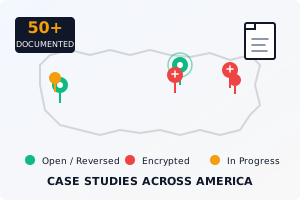
What Denver Lost
The real-world consequences of going dark
Emergency awareness
During wildfires, severe weather, and active threats, residents have no direct line to police communications. Official notification systems consistently lag behind events on the ground.
School lockdowns
Parents whose children attend Denver-area schools can no longer monitor police response during a lockdown. There is no way to know what is actually happening at the scene.
Press independence
Denver newsrooms now depend on police to learn about police activity. There is no independent check on what the department chooses to announce.
Accountability
No public record of radio communications means misconduct is harder to surface. Residents have one fewer tool for monitoring how the department operates.
Colorado's Failed Promise: HB21-1250
In 2021, Colorado passed HB21-1250, a statewide law requiring law enforcement agencies that encrypt all of their radio traffic to establish media access policies. Journalists, civil liberties groups, and transparency advocates pushed hard for the provision.
The law requires:
- Written policies for credentialed media access to encrypted communications
- A process for journalists to apply for access
- Reasonable timeframes for reviewing applications
The result has been paperwork, not access. Agencies created policies, but actual access agreements are rare and often come with heavy strings attached — Aurora's, for example, requires news outlets to indemnify the department against claims arising from the agreement. The law has no meaningful enforcement mechanism.
A year after the law passed, the Colorado Freedom of Information Coalition reported that Denver-area news outlets were still blocked from listening to encrypted dispatch.
What You Can Do
Denver metro encryption is in place, but the policy is not settled:
- Contact your city council and push police departments to actually implement media access under HB21-1250, not just write a policy document
- Support local news organizations, which need resources to pursue access agreements and legal challenges
- Attend public meetings and raise transparency concerns when police budgets come up
- If you were harmed by the lack of real-time information during an emergency, write it down and share it with elected officials and advocacy groups
- Colorado State Patrol dispatch and some county agencies are still in the clear. Tell those officials you value that choice before it disappears too
- HB21-1250 lacks enforcement teeth. Advocate for amendments with real penalties for non-compliance
Take Action for Transparency
Your voice matters. Here are concrete ways to advocate for open police communications in your community.
Contact Your Representatives
Use our templates to email your local officials about police radio encryption policies.
Get StartedRead Case Studies
See how encryption has affected real communities - from Highland Park to Chicago.
View CasesSpread Awareness
Share evidence about police radio encryption with your network and community.
Public Testimony
Learn how to speak effectively at city council and public safety meetings.
Prepare to SpeakFrequently Asked Questions
When did Denver Police encrypt their radio communications?
Denver Police Department encrypted its radio communications in late July 2019, after nearly a year of internal deliberation. Aurora Police had already gone silent in 2016, and other Front Range agencies have followed since — Boulder Police encrypted in October 2025.
How did encryption affect communication during the Marshall Fire?
The December 2021 Marshall Fire destroyed over 1,000 homes in Boulder County. Residents reported confusion about evacuation zones as official alerts lagged. Denver and Aurora police radio was already encrypted by then, and the fire showed how much real-time information matters when alerting systems fall behind a fast-moving emergency.
Can parents monitor police channels during school lockdowns in Denver?
No. Since Denver Police encrypted in 2019, parents cannot monitor police response during school lockdowns. Families who previously used scanners to follow developing situations at their children's schools no longer have that option.
Did Colorado's media access law (HB21-1250) restore scanner access?
Colorado passed HB21-1250 in 2021, requiring agencies that encrypt all their radio traffic to adopt media access policies. Implementation has been uneven. A year after passage, the Colorado Freedom of Information Coalition reported Denver-area news outlets were still blocked from listening.
Are any Denver-area agencies still unencrypted?
Some remain audible. Colorado State Patrol dispatch is still in the clear on the statewide DTRS system, with live Broadcastify feeds, and Weld County Sheriff traffic is also streamed live. Most Denver metro municipal police departments have encrypted. Check RadioReference for the current status of any specific agency.
What you can do
Encryption is a policy choice, not a technical requirement. Here are the next steps that have worked in Denver and elsewhere.
Sources & further reading
- CPR News: "The Denver Police Just Encrypted Their Scanners And Journalists Are Protesting The Silence" (August 2019)
- Colorado Freedom of Information Coalition: "A year after the legislature passed a law on police radio encryption, Denver-area news outlets are still blocked from listening" (August 2022)
- Colorado Freedom of Information Coalition: "Its radio transmissions encrypted since 2016, Aurora police considered — then rejected — a delayed public feed"
- Colorado Freedom of Information Coalition: "Boulder police radios going encrypted means public, press won't be able to listen in" (October 2025)
- Colorado General Assembly: HB21-1250 text and legislative history
- Denver PD decryption license agreement for media (June 2019)
- RadioReference.com and Broadcastify: Colorado DTRS and Front Range feed status