Eric Garner 2014: Scanner Access and Police Accountability
On July 17, 2014, Eric Garner died during an arrest by NYPD officers on Staten Island, touching off a national debate on police accountability. What is often overlooked is that NYPD radio was still open to the public when it happened. Under encryption today, the same level of independent awareness would not exist.
Accountability scanners: what still works post-NYPD encryption
With NYPD's radio encryption rollout — phased in borough-by-borough from 2023 and completed by early 2026 — the real-time accountability window that documented the Garner case no longer exists in New York. No receiver can rebuild it—encryption is the problem. What a press or accountability setup can still cover: federal task forces, aviation over the city, amateur nets active during protests, NOAA weather, and any unencrypted adjacent agencies.
New York before encryption
In 2014, NYPD operated on open radio frequencies anyone could monitor. That had been true for generations. New York journalists, community organizations, and ordinary residents had long used police scanners to understand what was happening in their neighborhoods.
That open access meant:
- News assignment desks monitored scanners to dispatch photographers and reporters to breaking events.
- Community organizations tracked police activity in their neighborhoods.
- Copwatch groups mobilized to document police interactions.
- Independent journalists could follow police activity without official access or press credentials.
- Civil rights attorneys monitored for potential misconduct cases.
When significant police incidents occurred, independent awareness existed outside official channels.
What open scanner access provided
- Journalists and monitors learned about the incident as it was happening, not hours later through official channels.
- Multiple parties could respond to verify and document events independently.
- Scanner traffic provided independent records of response times and police narratives for timeline verification.
- Long-term monitoring revealed patterns in police activity across neighborhoods.
- Communities understood police presence and activity in their area in real time.
What open radio enabled
The Eric Garner case became one of the most significant police accountability moments in recent American history. "I can't breathe," Garner's words during the arrest, became a rallying cry for police reform movements nationwide.
The coverage and public discourse that followed depended in part on the open information environment that existed in 2014:
2014: Open Scanner Access
- Journalists alerted by scanner traffic
- Rapid media response to scene
- Independent monitoring of police statements
- Community awareness in real-time
- Multiple information sources for verification
- Historical record of communications
Today: NYPD Encrypted (2023-2026 rollout)
- No scanner alerts to journalists
- Media dependent on official statements
- No independent verification capability
- Communities unaware until told
- Single source of information: police
- No independent communication records
The counterfactual
No one can say exactly how events would have unfolded under encryption. But we can say what would not have existed if NYPD had been encrypted in 2014:
- Journalists would not have been alerted by scanner traffic
- Community monitors would not have had real-time awareness of the incident
- The initial news cycle would have started from NYPD's official narrative
- Independent timeline verification would have been impossible
- Pattern data about police activity in that area would not have existed
The bystander video that proved essential to public understanding existed independently of scanner access. But scanner access contributed to the broader monitoring environment that surrounded the case and shaped the coverage that followed.
The years in between
In the roughly nine years between Eric Garner's death and the start of NYPD's borough-by-borough encryption rollout in 2023, the department had ample opportunity to document cases where scanner access endangered officers or operations. It produced no such evidence.
When NYPD began encrypting in 2023, the move came without any public record of specific harms caused by open radio. The benefits of open access, on the other hand, were well documented by then.
Eric Garner incident occurs with NYPD radio open
Nine years of open radio access continue without documented harm
NYPD rolls out full encryption borough by borough, ending public monitoring
The same pattern, other cities
The Eric Garner case is part of a pattern: the moments that most demand police accountability are also the moments when scanner access matters most.
- In Ferguson in 2014, scanner access helped journalists cover police responses to protests.
- In Baltimore in 2015, open radio gave reporters context during the Freddie Gray unrest.
- In Minneapolis in 2020, scanner monitoring ran throughout the George Floyd protests.
In each case, open radio provided independent information that shaped public understanding of police activity. As more departments encrypt, that independent source disappears.
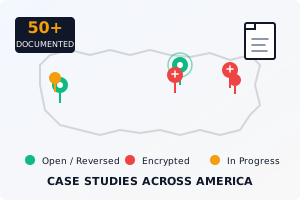
The accountability we're losing
What encryption eliminates from public discourse
Police departments typically frame encryption as a technical or security decision. The Eric Garner case shows it is an accountability decision.
When police radios are encrypted:
- The public loses the ability to independently monitor police activity
- Journalists rely on official statements rather than real-time information
- Community monitoring becomes impossible
- Records of police communications are controlled solely by the department
- Accountability coverage is slower and thinner
These are not abstract concerns. They are the specific mechanisms that made thorough coverage of Garner's death possible. Without open scanner access, future incidents will unfold in an information environment controlled entirely by police.
What this means now
Eric Garner's death changed how millions of Americans think about policing. That shift was possible in part because the open information environment let journalists, community members, and civil rights advocates document, verify, and discuss what happened in real time.
The accountability reforms Garner's case inspired require the tools that made accountability possible in the first place—including public access to police radio.
Take Action for Transparency
Your voice matters. Here are concrete ways to advocate for open police communications in your community.
Contact Your Representatives
Use our templates to email your local officials about police radio encryption policies.
Get StartedRead Case Studies
See how encryption has affected real communities - from Highland Park to Chicago.
View CasesSpread Awareness
Share evidence about police radio encryption with your network and community.
Public Testimony
Learn how to speak effectively at city council and public safety meetings.
Prepare to SpeakRelated resources
Frequently Asked Questions
What does the Eric Garner case show about police scanner access?
The 2014 Eric Garner case occurred when NYPD radio was still open to the public. Scanner access allowed journalists to quickly respond to the scene, independent monitors to document the incident, and the public to understand what was happening. Today, with NYPD encrypted, this level of independent awareness would not be possible.
Could the Eric Garner incident have been covered differently with encryption?
Yes. If NYPD had been encrypted in 2014, journalists would not have been alerted by scanner traffic, independent community monitors wouldn't have been listening, and the initial media response would have relied entirely on official NYPD statements. The accountability coverage that followed may have been delayed or diminished.
When did NYPD encrypt their radio communications?
NYPD's radio encryption rolled out borough-by-borough, starting around July 2023 and continuing into early 2026. NYC Local Law 46 of 2026 (effective January 17, 2026) now governs the framework for public and media access to the encrypted system. The phased transition eliminated the public monitoring capability that had existed for generations in New York City.
Why is the Eric Garner case relevant to police radio encryption?
Garner's death sparked a national conversation about police accountability, and the open-radio environment of 2014 contributed to how quickly journalists and the public understood what had happened. The case shows concretely what is lost when police communications are encrypted.
How did scanner access contribute to accountability in the Eric Garner case?
Scanner access meant journalists and community monitors knew about police activity in real time. That enabled rapid response to the scene, immediate documentation, and independent verification—all of which contributed to the coverage and public debate that followed.
Sources and further reading
- Department of Justice investigation into NYPD practices
- New York Civil Liberties Union reports on police oversight
- Academic studies on media coverage of police accountability cases
- Historical records of NYC scanner-based journalism
What you can do
Encryption is a policy choice, not a technical requirement. Here are the next steps that have worked in New York City and elsewhere.